


 Lelun Afrin
Introduction
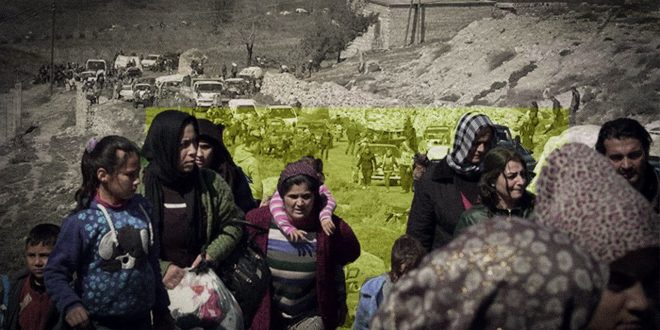
Syria is undergoing profound political and security transformations, accompanied by attempts to establish a new state order. Within this context, thousands of individuals who were forcibly displaced are returning to the Afrin region in the hope of reclaiming homes and properties from which they were uprooted years ago.
However, return does not equate to restitution. Many returnees find their properties still occupied or controlled by individuals affiliated with factions of the Syrian National Army (SNA), which have since been incorporated into the institutional framework of the new state under the designations of “General Security Service” or military divisions subordinate to the Syrian army.
In the years following Operation Olive Branch, Afrin witnessed widespread and systematic human rights violations attributed to SNA factions. These included extrajudicial killings, enforced disappearances, torture, rape, forced displacement, and the systematic seizure of homes, commercial properties, and agricultural land. Despite the fall of the Assad regime, these violations have not been adequately addressed. Instead, many of the same actors have assumed formal positions within emerging state institutions, reinforcing fear and insecurity among displaced communities who had sought refuge in multiple areas across Syria.
Residents of Afrin experienced repeated waves of displacement, many ultimately regrouping in the cities and towns of Al-Hasakah and Al-Qamishli under the control of the Syrian Democratic Forces. Today, considering ongoing agreements between the new authorities and the Syrian Democratic Forces that include provisions for the return of Afrin’s displaced population, organized return convoys have been publicly announced.
This report, drawing on prior documentation by the UN Independent International Commission of Inquiry and numerous human rights organizations, as well as recent testimonies collected by “Lelun Association for Victims” of violations against returnees to Afrin, demonstrates that return does not necessarily restore rights. Numerous families were confronted with demands for substantial financial payments from current occupants as a condition for vacating their homes. Others encountered deliberate obstruction and evasion. In many cases, despite filing complaints, families have been unable to recover their properties. Preliminary estimates indicate that thousands of homes, along with a significant number of commercial properties, remain occupied by non-owners, in the absence of any effective investigative mechanism or clear restitution process.
Patterns of Violations Based on Recent Testimonies
Lelun Association for Victims obtained multiple recent testimonies from returnees to Afrin who were unable to repossess their homes. Names have been anonymized to protect witnesses from retaliation.
- Financial Extortion as a Condition for Access
Several returnees reported being required to pay large sums to regain possession of their property:
- One witness (Kh.B.) returned on 15 January 2026 to find an armed individual affiliated with the “Amshat” faction demanding USD 5,000 in exchange for vacating the home.
- Another witness (R.S.) reported that the current occupants claimed to have “purchased” the house from the same faction for USD 3,000 and refused to leave without reimbursement.
- A third returnee (A.S.) found her home occupied by a member of General Security who demanded USD 1,000 to vacate.
- (M.A.) stated: “After the fall of the Assad regime, we returned to our village. A commander from the Amshat faction was living in our house. He told us he would not leave unless he was transferred from the area. We left again and later returned after leaving Raqqa. He told us that he had not yet been transferred and would not leave until a transfer order was issued. Even if he leaves, we would have to pay the expenses he claims to have spent on the house.”.
- Witness (F.L.) stated: “I have three houses and one shop. I was unable to access any of them. All are occupied by strangers. One house is inhabited by a General Security member, and two houses are occupied by displaced persons from other areas. All of them refuse to leave.” In some cases, homes stand empty, yet former occupants retain keys and demand payment to allow entry.
- (N.K.) stated: “I returned to my village, Anqala. For four months I have been sleeping in other people’s houses because my home is occupied by a member of the Amshat faction. He has been living in it for three years and refuses to leave.”
- (H.L.) stated: “Although no one is living in our house, the person who used to live there still has the key and prevents us from entering. He is demanding one thousand euros to allow us to enter our own home.”
- While (R.T.) said: “I returned to my home in Afrin, but the person who has been living there for six years refuses to leave. I cannot do anything because the person who has taken my house is one of the judges in the area.” These accounts indicate a pattern of extortion, abuse of authority, and coercive appropriation.
- Absence of Effective Complaint and Redress Mechanisms
Returnees consistently reported the absence of accessible and impartial grievance mechanisms:
- Witness (Kh.B.) stated: “I filed a complaint with the district authority, but without result. I understood from them that they are unable to remove the person occupying my house because he belongs to the Amshat faction.”
- Witness (A.S.) stated: “When we asked the General Security member occupying our house to leave, he threatened to file a complaint against us, accusing us of belonging to the PKK if we demanded the house again. We are afraid to file a complaint because he has connections and we could be harmed.”
- Witness (M.A.) stated: “The person occupying our house holds a high-ranking position within the Amshat faction. We are afraid to file a complaint against him, especially since I was imprisoned in Afrin for six years without any wrongdoing.”
- Witness (F.L.) stated: “My three houses are occupied by people who refuse to leave. I cannot file complaints against them because one is a General Security member and the others have relatives in General Security who threaten us. Due to many stories I have heard about their ability to retaliate, I have not submitted any complaint.”
- Witness (H.L.) stated: “We filed a complaint against the person who has taken our house. Although no one lives in it and it is empty, we did not benefit from the complaint, and no one took action to help us access our home.”
- Witness (R.T.) stated: “To whom can I complain if the person who has taken my house is a judge?”
- Military Zones Preventing Return
Residents of at least five villages (Al-Jabaliya/ Çê, Darwish/ Dêrwîş, Sheikhorz/ Sêxurzê, Jilbul/ Jilbilê, and Baselhaya/ Basilhiyê) report being categorically prevented from returning due to the presence of Turkish military bases. Even harvesting olive crops is subject to complex approval procedures. Complaints to local authorities reportedly resulted in responses indicating that the matter falls under the jurisdiction of the Turkish Ministry of Defense, leaving affected civilians without remedy.
Legal Analysis
The documented practices constitute ongoing unlawful seizure of property and are accompanied by extortion, threats, and abuse of authority. In most cases, alleged perpetrators are affiliated with military or security institutions, effectively obstructing access to justice.
These acts violate Syrian constitutional and statutory law. Article 16 of the Constitutional Declaration guarantees the protection of private property and stipulates that expropriation may occur only for public benefit and with fair compensation. Syrian criminal law classifies unlawful seizure of real property as a punishable offense, with aggravated penalties where influence or official capacity is abused. Acts of threat and defamation are likewise criminalized.
From the perspective of international law, these practices violate both international human rights law and international humanitarian law, including protections against arbitrary deprivation of property, forced displacement, and discrimination.
The persistence of such violations, coupled with state inaction, undermines institutional legitimacy and erodes public trust in emerging governance structures.
Recommendations
To the Syrian Authorities
- Adopt all necessary measures to ensure the safe and unconditional return of displaced persons to their homes, without requiring individual complaints as a prerequisite.
- Initiate prompt investigations, prosecute perpetrators of property seizure, and guarantee compensation to rightful owners for the period of unlawful occupation.
- Safeguard judicial independence and establish secure, accessible complaint mechanisms.
- Prevent military and security actors from interfering with civilians and ensure accountability for any violations.
- Ensure that all victims are included within a comprehensive transitional justice framework, including accountability for abuses committed by SNA factions and effective reparations.
- Empower the National Commission on the Missing to clarify the fate of individuals detained or disappeared in faction-run facilities.
- Actively counter hate speech targeting Kurdish communities and implement accountability measures.
To Syrian and International Organizations
- Prioritize support for returnees to Afrin to ensure dignified and safe return, including provision of basic services.
- Document ongoing violations affecting returnees and advocate on their behalf.
- Provide legal assistance to returnees and victims.
- Deliver medical, psychosocial, and economic support to address the long-term consequences of widespread abuses.
- Increase international scrutiny of violations committed by SNA factions and pursue accountability at both national and international levels.
To International Accountability Mechanisms
- Ensure the continued work of the UN Independent International Commission of Inquiry and prioritize violations committed in Afrin.
- Focus the mandate of the International, Impartial and Independent Mechanism (IIIM) on ongoing and past large-scale violations in Afrin.
- Prioritize efforts by international bodies addressing missing persons to clarify the fate of those detained in SNA-run facilities.
To the International Community
- Closely monitor the human rights situation, particularly violations involving ethnic discrimination, and ensure compliance by Syrian authorities with international obligations.
- Activate universal jurisdiction mechanisms to combat impunity and prosecute perpetrators present in states recognizing such jurisdiction.
- Urge the Turkish government to disclose information regarding violations involving Syrian and Turkish officials in northern Syria.
- Promote cooperation between Turkish and Syrian authorities to ensure returnees’ access to homes located within areas hosting Turkish military bases and to guarantee appropriate compensation.
Return without restitution, protection, and accountability cannot constitute a durable solution. Without structural remedies and effective enforcement of rights, displacement and dispossession will remain unresolved.
Lelun Association for Victims
You can download the briefing and view it in full by clicking on the link