


 Lelun Afrin
Northern Syria is experiencing a renewed wave of forced displacement, once again affecting civilians who had previously been uprooted from Afrin and other parts of the country. This latest development reflects a persistent pattern of repeated displacement, marked by ongoing violations and the continued absence of durable, rights-based solutions.
In recent weeks, areas of north-eastern Syria, alongside the neighbourhoods of Sheikh Maqsoud and Ashrafieh in Aleppo, have witnessed large-scale displacement following renewed military escalation involving Syrian government forces and the Syrian Democratic Forces. Thousands of families – many of whom were forcibly displaced from Afrin after Operation “Olive Branch” on 18 March 2018 – have again been compelled to move between multiple locations. Their displacement initially led them to the Shahba area, where families lived for extended periods in camps and makeshift housing that failed to meet minimum living standards. They were subsequently forced to flee once more towards north-eastern Syria, including Raqqa, Tabqa, Hasakah, Qamishli, Amuda, Derik and Kobani, as well as the Sheikh Maqsoud and Ashrafieh neighbourhoods of Aleppo.
Throughout these repeated movements, displaced civilians have been exposed to serious violations, including the absence of security guarantees and arbitrary arrest and executions. These abuses, combined with extremely harsh living conditions, have had a severe impact on individuals and families, undermining their psychological well-being, social stability, and overall humanitarian situation.
Within this context, Lêlûn Association for Victims has documented multiple testimonies illustrating the violations accompanying forced displacement.
One such testimony was provided by (L.D.), a woman forcibly displaced from the Ashrafieh neighbourhood in Aleppo, who told a Lêlûn researcher:
“On 7 January 2026, I was forced to leave the neighbourhood with my family and head towards Afrin following a major security escalation. We left in the evening as part of a group of several families. Among us was a boy who had been injured by shrapnel in his hand. A group affiliated with the Syrian government stopped us until around four in the morning. They searched our mobile phones and questioned us about our names, before arresting all the young men in the group. They then killed the injured boy in front of his mother, claiming he was a ‘combatant’, despite her repeated pleas and her insistence that he was a civilian with no connection to any armed group.”
Another testimony, provided by a displaced woman currently residing in Raqqa, documents a further killing during forced movement. (F.W.) stated:
“After we were forcibly displaced from Afrin following Operation “Olive Branch”, we were again displaced from Shahba around a year ago and ended up living in camps in Raqqa. When we later decided to leave with our family and several other families towards Qamishli, an armed group intercepted us on the Raqqa–Hasakah road. They forced everyone out of the vehicle and killed the young driver in front of us. We were then threatened with death and forced to recite the Shahada until another armed group arrived and allowed us to leave – without letting us take the young man’s body. There were no security guarantees whatsoever for civilians travelling on that road.”
Preliminary information indicates that the killing occurred at an armed checkpoint, highlighting the acute risks faced by displaced civilians during forced movements and the absence of effective protection.
In another case, Lêlûn documented the death of Hussein Al-Nasser, a 17-year-old boy from Afrin, who lost his life during displacement with his family after arriving in Qamishli. (Y.R.), a witness close to the family, stated:
“After reaching Qamishli, Hussein suffered severe and repeated convulsive seizures due to the cold, intense fear, and the beating he endured at the hands of an armed group affiliated with the current government on the road to the city. He died shortly afterwards.”
Further violations were reported by (S.A.), whose relatives were subjected to abuse during the military escalation in Sheikh Maqsoud. She stated:
“A family of my relatives in Sheikh Maqsoud was threatened and robbed by an armed group affiliated with the government. They took the man away and brought him back several hours later, then threatened to kill the entire family with live ammunition unless they handed over everything they owned. The women were forced to give them all the gold and money in the house.”
More recently, additional waves of displaced families from Raqqa and Tabqa have arrived in various areas of Hasakah governorate, Qamishli, and the city of Derik. These new arrivals have placed further strain on already overstretched infrastructure and basic services. Field data collected by Lêlûn indicate that most of these families have been displaced multiple times and remain unable to return safely to their areas of origin, in the absence of security guarantees that would protect them from arrest or further violations, or ensure the restitution of their homes and property.
Displacement has been compounded by the geographical dispersion of families across reception areas, making it difficult to accurately assess numbers and needs. This fragmentation has hindered coordination among humanitarian actors and delayed the delivery of urgent assistance to the most vulnerable groups.
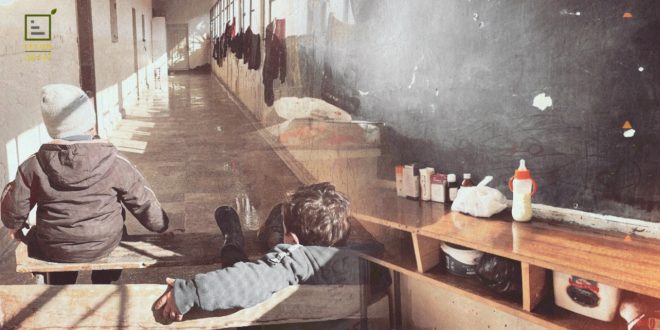
Families are also facing acute shortages of shelter and essential items, particularly amid harsh winter conditions and falling temperatures. Many struggle to secure safe accommodation, whether in camps or informal housing. Urgent needs include mattresses, blankets, basic hygiene items, and infant formula, leaving women, children, and older persons exposed to heightened health and protection risks.
The growing number of displaced people is placing increasing pressure on healthcare and psychosocial support services. There is an urgent need for medication for chronic illnesses, maternal and child healthcare, and sustained mental-health support for those affected by repeated displacement and exposure to violence.
These humanitarian challenges have unfolded alongside an increase in hate speech promoted through platforms linked to the transitional authorities, restrictions on independent media coverage, and inciteful religious rhetoric portraying Kurds as “apostates”. Such discourse, documented in publicly circulated video material, has contributed to an environment in which violence against civilians and their property is normalised and implicitly legitimised.
Considering these findings, Lêlûn Association for Victims stresses the urgent need for a strengthened and sustained humanitarian response by international organisations and relevant actors, with priority given to the most vulnerable groups. The Association further emphasises the need to address the long-term consequences of displacement in a manner that upholds dignity and fundamental rights, foremost among them the right to safe, voluntary, and dignified return.
The United Nations Office for the Coordination of Humanitarian Affairs (OCHA) has warned of a sharp increase in displacement across Aleppo, Hasakah, and Raqqa governorates since mid-January 2026, with more than 170,000 people newly displaced, most of them concentrated in Qamishli and Al-Malikiyah/Derik. This has further strained infrastructure and basic services. Despite the extension of the ceasefire, the security situation remains fragile, with overcrowded shelters and severe shortages in housing and healthcare – particularly affecting children and pregnant and breastfeeding women.
Similar concerns have been raised by the International Committee of the Red Cross (ICRC), which has warned of a deepening humanitarian crisis in north-eastern Syria. The ICRC notes that civilians continue to bear the brunt of renewed hostilities and repeated displacement amid a harsh winter and critical shortages of water, heating, and healthcare. It has also highlighted serious risks to civilian infrastructure, detention facilities, and camps, raising grave concerns for the safety and dignity of detainees and camp residents, and has called on all parties to ensure civilian protection and unimpeded humanitarian access.
UNICEF has likewise warned of escalating violence across Aleppo, Hasakah, Raqqa, and Kobani since mid-January 2026, reporting the displacement of more than 165,000 people, 70 per cent of whom are women and children, as well as damage to camps and essential infrastructure such as water and electricity, exposing affected communities to severe health and protection risks.
Human Rights Watch has also expressed alarm, noting that the recent escalation has exposed serious failures by parties to the conflict to protect civilians. The organisation has warned of potential violations of international humanitarian law, including arbitrary detention, restrictions on humanitarian access, and the cutting of water and electricity supplies. It has cited credible reports of extrajudicial killings, the desecration of bodies, and grave risks facing residents of camps and detention facilities – particularly in Al-Hol and Roj – and has called for immediate humanitarian access, the release of those arbitrarily detained, and independent investigations into all alleged violations.
Finally, the International Organization for Migration has reported that more than 130,000 people have fled their homes in Raqqa, Tabqa, and Ain Issa following the entry of Syrian Ministry of Defence forces into these areas, moving towards locations under the control of the Syrian Democratic Forces in north-eastern Syria, including Qamishli and Hasakah. Many displaced families cited fears of a repetition of the massacres previously witnessed in Syria’s coastal region and in Suwayda as a key factor driving their flight