


 Lelun Afrin
Introduction
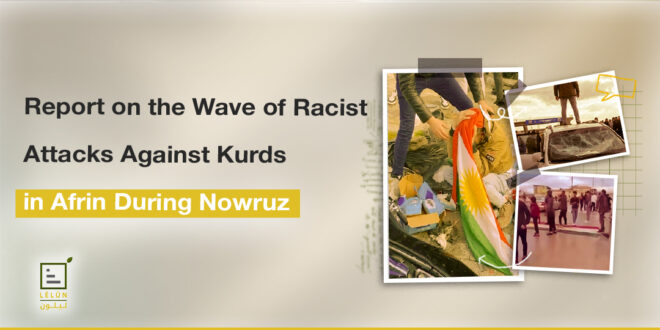
On March 21, during Nowruz celebrations, the Afrin region and the areas connecting it to the city of Aleppo witnessed a widespread wave of violations and attacks targeting the Kurdish population. These incidents were accompanied by hate speech and incitement directed against the Kurdish community.
The documented violations included the blocking of roads, arbitrary arrests, acts of torture, and the humiliation of Kurdish cultural symbols, including traditional dress and the Kurdish flag. Women were also subjected to abuse. Available evidence indicates that these acts were not isolated incidents, but rather formed part of a broader, systematic pattern of targeting the Kurdish community in conjunction with their holiday.
In line with its mandate to defend human rights and document violations, the Lelun Association for Victims monitored these events and collected evidence through both open-source materials and testimonies gathered by its field teams from victims and their families.
The information and evidence collected indicate that these events constitute part of an ongoing pattern of systematic targeting of the Kurdish community. This reflects a continuation of the conduct of Syrian National Army factions, whose violations in Afrin have previously contributed to the displacement of the majority of the region’s predominantly Kurdish population. Superficial changes in names or appearance have not altered this pattern of conduct.
Context
In the days leading up to Nowruz, racist campaigns targeting Kurds began to escalate, originating both from segments of the population newly settled in Afrin and from authorities.
Several incidents were recorded in the days preceding the holiday, particularly on the eve of Nowruz. A number of Kurdish youths were detained for raising the Kurdish flag or wearing symbols associated with their identity. Authorities also reportedly instructed shop owners not to display the Kurdish flag and informed local officials that doing so would require prior authorization.
On the day of Nowruz, Kurds gathered in public spaces to celebrate. In a separate incident, an individual in Kobani removed the Syrian flag as a personal reaction to prior developments in northern and northeastern Syria. News of this act circulated widely among hostile groups, triggering a wave of mobilization and incitement against the Kurdish community.
In Afrin and surrounding areas, hundreds of individuals mobilized, establishing checkpoints and blocking roads. This was followed by acts of violence and retaliation targeting Kurds. Individuals attempting to return to Aleppo were stopped at these checkpoints, subjected to insults, and physically abused.
These violations occurred in full view of public security forces and official authorities, without any intervention to protect civilians. In several documented cases, official personnel were directly involved in the abuses.
Based on the collected evidence and open-source documentation, the violations can be summarized as follows:
Humiliation of Kurdish Symbols
Groups targeting Kurds assaulted and insulted individuals wearing Kurdish attire or displaying the Kurdish flag. In one documented incident, a checkpoint placed a Kurdish flag on the ground and forced vehicles traveling toward Aleppo to drive over it under threat of arrest. Such acts constitute a direct attack on Kurdish identity.
Arbitrary Arrest and Torture
A number of Kurdish youths were detained without clear legal basis or charges. Arrests were carried out on the basis of identity, clothing, or the display of Kurdish symbols. At checkpoints, individuals were forcibly removed from vehicles, beaten in front of their families, and subjected to verbal abuse targeting their ethnic identity. In several cases, Kurdish women were also subjected to abuse, including acts amounting to torture, due to their traditional attire.
Selective Curfew Targeting Kurds
Following the wave of violations, authorities imposed a curfew that was applied exclusively to the Kurdish population. Kurds were confined to their homes, while those responsible for incitement and attacks continued to move freely without restriction.
Incitement and Hate Speech
Multiple instances of hate speech against the Kurdish community were documented. The actions of one individual in Kobani were generalized to the entire Kurdish population, with calls for collective retaliation. This reflects a pattern of collective incitement similar to previous cases involving other communities in Syria.
Attacks on Property
Dozens of cases of property damage were recorded, including the destruction of vehicles belonging to Kurds – particularly those displaying Kurdish flags – and the confiscation of items associated with Nowruz celebrations.
Responsibility of the Authorities
Dozens of attacks targeting Kurds solely on the basis of their identity were documented. These violations took place in the presence of authorities, who allowed perpetrators to establish checkpoints on public roads and commit abuses without intervention.
In several cases, members of public security forces were present during the violations; in others, they directly participated.
Despite the widespread circulation of video and photographic evidence documenting these abuses, no effective measures were taken to protect civilians. On the other hand, authorities arrested the individual in Kobani who removed the Syrian flag and broadcast images of him issuing an apology.
No corresponding acknowledgment or apology was issued for the violations committed against the Kurdish community, nor were those responsible held accountable. This disparity strongly indicates that these acts occurred with the knowledge, acquiescence, or protection of the authorities.
These events reflect a continuation of a pattern established since Operation Olive Branch, aimed at humiliating and displacing the Kurdish population in Afrin. Furthermore, the events demonstrate that the protection of rights cannot be achieved through formal declarations alone, but requires effective enforcement and accountability in practice.
The evidence also indicates that these attacks were not a spontaneous reaction to the incident in Kobani. Rather, they point to the existence of an ongoing, systematic policy targeting the Kurdish community.
Recommendations
To the Syrian Government:
1. Issue an official apology to the Kurdish community for the violations committed during Nowruz.
2. Ensure accountability for all perpetrators, including officials who failed in their duty to protect civilians, and publicly disclose the outcomes of such proceedings.
3. Provide adequate compensation to those affected.
4. Facilitate the return of Afrin’s forcibly displaced people to their areas of origin, ensure the removal of unlawful occupants from their homes, and enforce restitution and compensation.
5. Conduct a comprehensive investigation into violations committed in Afrin since Operation Olive Branch, including enforced disappearance, torture, extrajudicial killing, sexual violence, and unlawful appropriation of property, and prosecute those responsible at both individual and command levels.
6. Initiate a comprehensive national dialogue process.
To the International Community:
1. Ensure the continuation of the mandate of the international commission of inquiry and the issuance of a dedicated report on violations against the Kurdish community.
2. Support the documentation of these violations before the International, Impartial and Independent Mechanism (IIIM), recognize them as potential crimes against humanity, and pursue accountability under universal jurisdiction.
3. Exert pressure on the Syrian government to fulfill its obligations within the transitional phase, including the establishment of a credible transitional justice process.
To Syrian Civil Society Organizations:
1. Continue documenting violations affecting the Kurdish community and advocate for their rights.
2. Prioritize efforts to counter hate speech, particularly against minority communities.
3. Provide legal assistance to victims to support access to justice and the restoration of rights.