


 Lelun Afrin
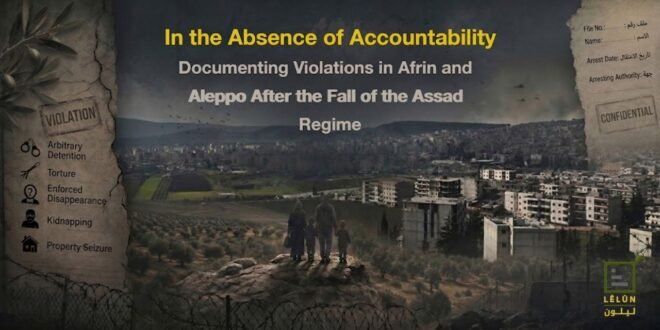
A Legal and Documentary Report on Arbitrary Detention, Torture, Forced Disappearance, Kidnapping, and Property Seizure
Executive Summary
This report documents the situation of the Kurdish population in Afrin and Aleppo – particularly in the neighbourhoods of Sheikh Maqsoud and Ashrafiyah – during the period following the fall of Bashar al-Assad’s regime on 8 December 2024. It is based on direct testimonies, in-depth interviews with victims and witnesses, and a review of Syrian and international human rights sources. The report aims to assess the impact of political and military transitions on the human rights landscape in the areas under study.
The report is based on the premise that a change in political authority does not, in itself, end violations or dismantle the structures that enable and perpetuate them. Accordingly, it not only documents individual incidents but also analyses recurring patterns and underlying structural factors. This is achieved through a comparison between violations documented during the post-regime period and those previously recorded in areas under the control of the Syrian National Army (SNA), particularly in Afrin.
The testimonies and evidence collected reveal the continuation of several violations – albeit at a reduced scale and with a lesser overall impact – including arbitrary detention and extrajudicial imprisonment, torture and ill-treatment, enforced disappearance, kidnapping for ransom, property seizure and related extortion, and extrajudicial killings. They also point to the continued risk of discrimination or targeting based on Kurdish ethnic identity. The findings further indicate that many victims continue to face difficulties in accessing justice, determining the fate of detained or missing relatives, and reclaiming their rights and properties.
The report does not conclude that there is complete continuity between the pre- and post-regime periods. The available evidence suggests a relative decline in the intensity of some violations compared with previous years. However, this decline has not been accompanied by sufficient institutional reform, the establishment of effective accountability mechanisms, or adequate guarantees against recurrence.
Ultimately, the current phase does not represent a complete break from previous patterns of violations in the areas examined. While some practices have diminished in scale or prevalence, structural risk factors remain, including a fragile rule of law, weak accountability mechanisms, and limited protection for civilians. Preventing the recurrence of violations will require addressing their structural causes, strengthening accountability, safeguarding victims’ rights, and developing effective mechanisms for truth, justice, and reparations.
Table of Contents
- Introduction ……………………………………………………………………..4
- Methodology …………………………………………………………………….4
- Background and Context …………………………………………………….5
- Arbitrary Detention and Extrajudicial Imprisonment ………………….8
- Torture, Ill-Treatment, and Forced Disappearance …………………..10
- Kidnapping for Ransom and Extortion Linked to Detention ………..11
- Property Seizure and Extortion Related to Reclamation ……………14
- Extrajudicial Killings …………………………………………………………15
- Analysis and Legal Qualification …………………………………………17
- Recommendations ………………………………………………………….23
Introduction
The fall of Bashar al-Assad’s regime in December 2024 marked a pivotal moment in modern Syrian history, reigniting fundamental questions concerning the future of human rights, the rule of law, and justice in the country. After years of conflict and grave violations, there was widespread hope that Syria might enter a new phase founded on respect for rights and freedoms, accountability, and justice for victims.
However, experiences of political transition in different conflict settings demonstrate that a change in power does not automatically erase the consequences of conflict or dismantle entrenched patterns of abuse. Without addressing structural causes – such as weak institutions, a fragile rule of law, and impunity – many violations persist or re-emerge in new forms.
In this context, the situation of the Kurdish population in Afrin and Aleppo – particularly in the neighbourhoods of Sheikh Maqsoud and Ashrafiyah – is of particular significance. These areas have witnessed years of conflict, displacement, and documented violations that have profoundly affected the lives and fundamental rights of their residents. As such, there is a pressing need to assess the state of rights and freedoms during the current phase and to examine the extent to which political transformations have translated into effective protection for civilians.
This report aims to contribute to an understanding of the human rights situation in the areas covered during the post-regime period. It does so by documenting and analysing incidents reported from the field within their broader political, social, and security context, thereby supporting efforts to strengthen accountability, protect victims’ rights, and prevent the recurrence of violations.
Methodology
The report is based on a qualitative methodology designed to document and analyse violations committed against civilians in the neighbourhoods of Sheikh Maqsoud and Ashrafiyah, the city of Afrin, and other relevant areas following the fall of the former Syrian regime. The analysis primarily draws on 20 testimonies collected from direct victims, eyewitnesses, and family members of individuals who experienced or were directly affected by the documented events.
Testimonies were gathered through semi-structured individual interviews using standardised documentation tools. The interviews focused on the circumstances of the violations, including their timing, location, and alleged perpetrators, as well as their impact on victims and their families. They also explored participants’ needs and perspectives regarding accountability and reparations. These testimonies constitute the report’s primary source of information, providing direct insight into documented incidents and broader patterns of abuse.
To strengthen the reliability of the findings, the report reviewed and analysed a range of open-source materials, including reports produced by Syrian and international human rights organisations, publications issued by United Nations bodies and international mechanisms concerned with Syria, as well as available visual materials and supporting documentation where possible. Information obtained through testimonies was cross-checked against independent sources whenever verification was feasible.
The report employs thematic analysis to identify principal patterns of violations and assess similarities and differences across documented cases. Particular attention is given to extrajudicial killings, arbitrary detention, enforced disappearance, torture, forced displacement, property seizure, hate speech, and their humanitarian, social, and economic consequences.
The report adheres to established ethical principles governing the documentation of human rights violations. These include obtaining informed consent from participants, respecting confidentiality and privacy, and taking appropriate measures to protect personal data and the safety of victims and witnesses. Pseudonyms were used, and identifying details were withheld where necessary to ensure protection.
It is important to note that this report does not purport to document all violations that occurred during the period under review. Rather, it seeks to present and analyse a selection of cases and testimonies that illustrate recurring patterns and significant indicators regarding the nature of the violations, their impact on victims, and their broader effects on affected communities.
Background and Context
Afrin: A Legacy of Ongoing Violations Since 2018
Afrin is one of the regions most frequently referenced in discussions of military occupation, forced displacement, and violations linked to ethnic identity in Syria. Since Syrian National Army (SNA) factions, backed by Turkey, took control of the region in March 2018 following Operation Olive Branch, Afrin has undergone profound changes to its security, administrative, and social structures, directly affecting the lives of civilian residents – particularly the Kurdish population, which historically constituted the majority in the area.
Over subsequent years, Syrian and international human rights organisations, including the UN Independent International Commission of Inquiry on Syria and Amnesty International, documented recurring patterns of violations, including arbitrary detention, enforced disappearance, torture, kidnapping for ransom, property seizure, the imposition of levies, and restrictions on Kurdish cultural and linguistic rights. Multiple reports, including a joint report involving Leylun, indicated that these violations were not isolated incidents but were often linked to a security and military environment characterised by multiple controlling factions, weak institutional oversight, and overlapping military and economic interests.
These practices contributed to an environment marked by distrust of local institutions, a high degree of fear surrounding the reporting of violations, and limited access to justice and remedies for victims. They also reinforced a widespread perception among segments of the Kurdish population that their ethnic identity had become a factor increasing their vulnerability to certain forms of abuse and discrimination.
In this context, Afrin has become a key reference point in international reporting on the human rights situation in northern Syria, making comparisons with developments in Afrin particularly important when assessing subsequent changes affecting Kurdish populations elsewhere.
Sheikh Maqsoud and Ashrafiyah: The Urban Space of Kurdish Presence in Aleppo
The neighbourhoods of Sheikh Maqsoud and Ashrafiyah constitute the most significant centres of Kurdish presence in Aleppo. During the Syrian conflict, these areas acquired additional importance as they hosted large numbers of displaced persons and refugees from various regions, particularly from Afrin following developments in 2018.
Due to their geographical location, demographic composition, and surrounding military dynamics, these neighbourhoods underwent successive changes in security and military control over the years. As a result, they were directly affected by the political and military transformations that took place in Aleppo Governorate and northern Syria more broadly.
Consequently, an environment emerged that, while distinct from the rural and semi-rural context of Afrin, shared similar vulnerabilities related to legal protection and security. Residents of Sheikh Maqsoud and Ashrafiyah frequently found themselves exposed to the consequences of conflicts occurring beyond their neighbourhoods, whether through sieges, armed clashes, restrictions on movement, or fears associated with political or ethnic affiliation.
These neighbourhoods also served as spaces of relative stability for thousands of displaced Kurds who had lost their homes or properties elsewhere. The military developments that later affected these areas and resulted in their transfer to the control of the Ministry of Defence of the transitional government were accompanied by numerous reported violations. Their impact was particularly severe given that many residents had already experienced displacement, repeated displacement, or the loss of property during earlier phases of the conflict. In response, Leylun issued a position paper and joined public statements condemning military operations and violations affecting civilians.
The Fall of the Syrian Regime and Subsequent Transformations
On 8 December 2024, Syria experienced an unprecedented political and military transformation with the collapse of Bashar al-Assad’s regime after more than five decades of rule by the Assad family and nearly fourteen years of armed conflict that fundamentally reshaped the country’s political and military landscape.
This development generated widespread expectations among large segments of the Syrian population regarding the possibility of entering a new phase grounded in the rule of law, respect for rights and public freedoms, and an end to the violations and impunity that characterised years of conflict. These expectations were reinforced by political commitments and public discourse emphasising the importance of building more accountable institutions capable of protecting civilians.
However, experiences of political transition in conflict-affected contexts demonstrate that changes in central authority do not automatically dismantle local networks of influence or the security and military structures that emerged during wartime. In many instances, local actors and patterns of conduct continue despite broader changes at the national level.
This dimension is particularly important in northern Syria, where different governing authorities and security structures have succeeded one another over the years amid the continued presence of local and regional armed actors and overlapping jurisdictions between formal and informal institutions. Assessing the impact of the regime’s fall on the human rights situation, therefore, requires more than an examination of general political developments; it necessitates scrutiny of conditions on the ground and the lived experiences of affected communities.
From this perspective, the report views the post-regime period as a practical test of the extent to which new political realities have addressed the accumulated legacy of violations from previous years. The central question is not merely whether violations have continued or declined, but whether the conditions that enabled them have been effectively dismantled or continue to persist in altered forms.
Why Compare the Two Phases?
The comparison between the pre- and post-regime periods is not intended to equate different actors or assume complete continuity between distinct contexts. Rather, it adopts a rights-based approach that focuses on the patterns of violations and their consequences for civilians, regardless of the identity of the responsible party.
The report is guided by the premise that the persistence of a particular pattern of violations – even where its intensity has declined or the alleged perpetrator has changed – may indicate deeper structural shortcomings relating to governance, accountability, or legal protection. Accordingly, the comparison is not intended to demonstrate equivalence between two periods but to assess whether political transformation has altered the conditions that enabled such violations to occur.
The findings indicate that some practices documented in previous human rights reporting did not disappear following the fall of the regime but continued, to varying degrees, in new contexts. This underscores the importance of examining both continuity and change, rather than characterising the post-regime period as either a complete rupture with the past or a direct continuation of it.
Through an analysis of the broader context, field testimonies, and the applicable human rights framework, the report identifies several key findings that contribute to understanding the situation of the Kurdish population in Afrin and Aleppo during the post-regime period. These findings are not derived from a single incident or testimony but from recurring patterns that emerged across the body of documented testimonies and supporting evidence.
Arbitrary Detention and Extrajudicial Imprisonment
Arbitrary deprivation of liberty is one of the most prevalent patterns of violations documented in this report. Testimonies from Afrin and Aleppo – particularly from the neighbourhoods of Sheikh Maqsoud and Ashrafiyah – indicate that detention was frequently carried out outside a legal framework grounded in clear legal grounds or recognised procedural safeguards. Instead, it took multiple forms, including arrests at checkpoints, detention during displacement, arrests inside civilian and medical facilities, detention of individuals attempting to flee military operations, and arrests based on general suspicion or actual or perceived affiliation with certain political or military entities.
Mahmoud’s testimony, a university student from Afrin residing in Sheikh Maqsoud, documents a mass arrest operation targeting dozens of young men as they evacuated alongside civilians through a corridor announced as a humanitarian passage. According to his account, large numbers of young men were detained en masse at one of the final crossing points. Security personnel separated families and detained the young men without conducting individual questioning or providing clear legal justification, instead levelling broad accusations of affiliation with the Syrian Democratic Forces (SDF). Mahmoud stated that his efforts to explain his civilian status as a university student did not result in his release; rather, he was transferred to detention together with others.
This testimony is particularly significant because it illustrates how displacement routes and humanitarian evacuation corridors can become sites of mass security screening conducted without basic legal safeguards, thereby exposing civilians to arbitrary detention at a moment when they should benefit from heightened protection.
Mustafa’s testimony, a healthcare worker, documents an arrest carried out inside a medical facility that continued to provide services to civilians and wounded individuals during a period of siege. According to his account, he was taken from the hospital at gunpoint while performing his medical duties, without the presentation of an arrest warrant or adherence to recognised legal procedures and was subsequently transferred to detention. This incident raises additional concerns regarding the protection of medical facilities and healthcare personnel in situations of armed conflict, where medical workers are entitled to special protection so long as they carry out humanitarian or medical functions and do not directly participate in hostilities.
Raed’s testimony adds another dimension to this pattern by documenting arrests carried out during attempts to flee military operations and subsequent detention across multiple facilities. He reported being detained after a group of civilians became trapped while attempting to escape an area affected by active hostilities. He was then transferred between several detention sites while blindfolded and with his hands bound. According to his account, he spent varying periods in different detention locations, some of which were severely overcrowded, without receiving clear information regarding the reasons for his detention, its expected duration, or the authority responsible for it. His testimony further indicates that detainees were transferred repeatedly between locations in a manner that increased their isolation from any form of effective legal protection and heightened their vulnerability to further abuse.
The testimonies also suggest that detention was not always linked to specific criminal allegations or clear individual evidence. Rather, it was often associated with general suspicion, occupational or social background, place of residence, or previous employment. In this context, Mahmoud and Raed reported that questioning focused primarily on their previous connections to institutions affiliated with the Autonomous Administration of North and East Syria or on the areas from which they originated, rather than on specific acts attributed to them. Other testimonies similarly indicate that residence in certain areas or association with particular social environments was sufficient to arouse suspicion and result in deprivation of liberty.
Taken together, these accounts point to an expansion of suspicion to encompass broad categories of civilians, departing from the principle of individual responsibility that underpins legal systems grounded in respect for human rights. They further suggest that arrest often functioned not as an end in itself but as the starting point of a wider pattern of violations. In the cases of Mahmoud, Mustafa, and Raed, arbitrary detention was followed by imprisonment in undisclosed or unclear locations, isolation from the outside world, and exposure to various forms of pressure and ill-treatment.
The gravity of this pattern therefore lies not only in the unlawful deprivation of liberty itself, but also in its role as the gateway to a broader series of interconnected violations affecting a range of fundamental rights enjoyed by detainees.
Torture, Ill-Treatment, and Enforced Disappearance
The testimonies collected for this report indicate that violations frequently extended beyond the unlawful deprivation of liberty and evolved into torture, various forms of cruel, inhuman, or degrading treatment, and situations in which detainees disappeared, or their families were left without information regarding their fate for prolonged periods. The accounts suggest that these practices often followed arbitrary detention directly, as detainees were transferred from unlawful detention into environments where legal safeguards diminished and the risks of torture and disappearance increased significantly.
Four testimonies – those of Saber, Fakhri, Joud, and Raed – reveal recurring patterns of torture and ill-treatment during detention, transfer, and interrogation. Saber reported being beaten, subjected to electric shocks, and flogged during interrogation before being placed in solitary confinement under harsh conditions characterised by extreme cold and inadequate food. While Fakhri stated that he was beaten, humiliated, deprived of food and water, and threatened with sexual violence against his wife and daughters, experiences that left lasting psychological effects following his release.
Joud, who was kidnapped and detained for several days, described being beaten with metal objects, burned, and deprived of food and sleep as part of efforts to pressure his family into paying a ransom for his release. His testimony indicates that torture was used not only to subjugate the victim but also to terrorise family members and compel compliance with financial demands. Similarly, Raed reported being beaten and insulted during his transfer to detention. He also described detention conditions characterised by severe overcrowding, inadequate food and water, and ethnically derogatory remarks directed at him because of his Kurdish identity.
The testimonies further demonstrate that ill-treatment was not limited to physical violence but also included deliberate humiliation, threats, and deprivation of basic necessities. Both Fakhri and Raed described detention conditions that fell far below minimum humanitarian standards, including overcrowding, severe shortages of food and water, and inadequate access to medical care, all of which exacerbated their physical and psychological suffering.
In addition to torture and ill-treatment, the available material reveals cases in which detainees were cut off from contact with their families or their fate remained unknown for prolonged periods. The case of Khaled is particularly illustrative. After his family was informed in 2018 that he had been killed – without the return of a body or any evidence substantiating his death – his fate remained unknown for years. In 2025, the family received information from individuals who claimed to have seen him alive in various detention facilities, reigniting uncertainty regarding his status. Caught between reports of his death and claims of his survival, the family remained unable to determine his whereabouts or fate owing to the absence of any official or reliable information.
Raed’s testimony illustrates another form of disappearance linked to detention. He reported being held for two months without his family knowing where he was being detained or whether he remained alive. Only later were family members able to obtain limited information regarding his location. This case demonstrates how unacknowledged detention can create a prolonged period of complete informational uncertainty, leaving families in a state of persistent anxiety and helplessness.
Taken together, these accounts reveal a close relationship between arbitrary detention, torture, and enforced disappearance. In the cases of Saber, Fakhri, Joud, and Raed, detention served as the entry point to torture and ill-treatment, while Khaled’s case illustrates how the consequences of detention can extend into years of uncertainty and psychological suffering for family members. These violations should therefore not be viewed as isolated incidents but as interconnected elements of a broader process that begins with the unlawful deprivation of liberty and develops into more serious violations affecting physical integrity, human dignity, and the right of families to know the fate of their relatives.
Kidnapping for Ransom and Extortion Linked to Detention
The testimonies collected for this report indicate that kidnapping for ransom has remained one of the most serious and consequential patterns of violations affecting the civilian population. The available evidence suggests that some victims were targeted not because of specific acts attributed to them, but because perpetrators perceived an opportunity to obtain financial gain from their families or wider social networks.
The impact of this pattern extends beyond the unlawful deprivation of liberty. It exposes victims to torture and ill-treatment, compels families to pay substantial sums of money under the fear of harm to their relatives, reinforces a climate of fear and distrust, and increases the vulnerability of affected communities to economic exploitation and insecurity.
The testimonies further indicate that kidnapping for ransom was not merely an isolated criminal activity but, in some cases, appeared to operate within a broader environment characterised by impunity, weak legal protection, and limited accountability.
The material collected for this report reveals that several victims were abducted despite the absence of any serious allegations linking them to criminal conduct or military activities. In some cases, the apparent objective of the abduction was the extraction of financial payments from relatives or family members. Families reported receiving direct demands for money in exchange for the release of detainees and described sustained pressure to pay sums that frequently exceeded their financial means.
These accounts suggest that some perpetrators treated victims as sources of financial gain, exploiting the fear, uncertainty, and helplessness experienced by families when a relative was detained or threatened.
The testimonies also indicate that torture was not used solely to obtain information or confessions, but in certain cases served as a mechanism to compel families to pay ransom. Some victims reported being severely beaten, burned, insulted, and deprived of food while in detention, while their families received repeated messages or calls demanding payment. In other cases, detainees were filmed while being subjected to violence or threats, and the resulting recordings were sent to relatives to intensify psychological pressure and secure compliance with financial demands.
These accounts demonstrate a clear intersection between torture and financial extortion, whereby the physical and psychological suffering of detainees became a means of coercing their families into making payments. Many families found themselves confronted with an impossible choice: pay sums they could not afford or risk the continued detention, abuse, or possible loss of a relative.
To raise the required funds, some families reported selling property, borrowing substantial amounts of money, or seeking financial assistance from relatives and acquaintances. In other cases, families were unable to meet the demands imposed upon them, resulting in prolonged detention or heightened uncertainty regarding the fate of the victim.
The consequences of kidnapping, therefore, extend well beyond the direct victim. The evidence indicates that these incidents often impose long-term economic and psychological burdens on entire families, with effects that may persist long after the immediate incident has ended.
Some testimonies further suggest that Kurdish identity was directly or indirectly relevant in the context of certain incidents. In some cases, victims reported that kidnappers used language or descriptions referring to their ethnic background during detention or torture. Other accounts indicated that the selection of victims may have been influenced, at least in part, by their association with Kurdish-majority areas or communities. While these accounts do not establish a uniform pattern, they provide additional indications of the continued exposure of Kurdish populations to particular risks and forms of abuse in certain contexts.
The impact of kidnapping for ransom also extends beyond individual victims and their families, affecting the wider community. Fear of abduction restricts freedom of movement, undermines economic and social activity, and weakens confidence in existing institutions and their capacity to provide protection or ensure access to justice.
Several testimonies indicated that reports of kidnapping incidents alone were sufficient to deter families from travelling, returning to certain areas, or pursuing claims relating to their rights and property out of fear that they might be exposed to similar violations.
The evidence further suggests that the persistence of kidnapping for ransom is closely linked to weak accountability and the absence of effective mechanisms for investigation and prosecution. In most documented cases, victims and their families were unable to obtain meaningful legal redress or identify those responsible for the violations committed against them. Fear of retaliation and a lack of confidence in law enforcement institutions also discouraged many individuals from filing complaints or pursuing legal remedies.
These circumstances demonstrate that addressing this pattern of abuse requires more than securing the release of victims. It also necessitates addressing the broader conditions that allow such practices to persist and enable perpetrators to evade accountability.
In conclusion, kidnapping for ransom remained a significant threat to the civilian population during the period covered by this report. The testimonies indicate that this pattern combined unlawful deprivation of liberty, torture, and financial extortion, causing severe physical, psychological, and economic harm to victims and their families.
The evidence further demonstrates that these violations cannot be understood in isolation from the broader context of weak legal protection, limited accountability, and the enduring consequences of previous conflicts. Reducing the prevalence of such violations, therefore, requires measures that extend beyond addressing individual cases, including dismantling kidnapping and extortion networks, strengthening accountability, and establishing effective mechanisms for victim protection, compensation, and reparations.
Property Seizure and Extortion Related to Reclamation
The testimonies collected for this report indicate that disputes and violations related to property remain among the most complex human rights issues facing the Kurdish population in Afrin and other areas of northern Syria. Despite the political and military transformations the country has undergone, many affected individuals have been unable to reclaim their homes, land, or other property in a safe and sustainable manner. At the same time, various forms of extortion and pressure linked to property rights have continued to be reported.
These violations are particularly significant because their consequences extend beyond direct material loss. They affect a broader range of rights, including the right to housing, the right to return, family and social stability, and the ability of individuals and communities to rebuild their lives after years of conflict and displacement.
The material collected for this report indicates that many of the property-related challenges faced by Kurdish residents today originate in events, decisions, and practices dating back several years. In many instances, the central issue is not solely the occurrence of new seizures but the continuing effects of confiscations, occupations, and other forms of interference with property rights that occurred during earlier phases of the conflict. As a result, complex disputes have accumulated in which questions of ownership, usufruct, displacement, and return are closely intertwined.
The testimonies suggest that many affected individuals continue to regard property-related issues as among the most consequential aspects of their daily lives because of their direct relationship to the economic and social security of their families.
Several witnesses reported that returning to homes or land was not always possible or safe, even after active hostilities had subsided. In some cases, property owners encountered obstacles that prevented them from regaining effective control over their property. Others described security concerns, as well as social and administrative pressures, that made return significantly more difficult than anticipated.
These accounts demonstrate that the restoration of property rights depends not only on the cessation of hostilities or changes in territorial control, but also on the existence of effective mechanisms capable of guaranteeing respect for property rights and protecting owners from threats, coercion, and undue pressure.
Leylun has documented cases in which affected individuals reported being subjected to financial demands or other forms of pressure in exchange for reclaiming, retaining, or utilising their properties.
In some instances, property owners stated that they were compelled to pay money or assume additional financial burdens in order to maintain their rights or avoid losing their property altogether. These accounts point to a connection between property disputes and certain forms of economic extortion, whereby rights relating to housing, land, or ownership become a source of pressure on victims or a means of obtaining unlawful financial gain.
Since Turkish-backed Syrian National Army (SNA) factions took control of Afrin in 2018, many residents – including those whose testimonies are reflected in this report – have experienced successive waves of displacement throughout the conflict. This reality has weakened the capacity of numerous families to protect their property, monitor its legal status, or defend their rights. It has also resulted in the loss of important ownership documents and supporting evidence due to repeated movement and difficult security conditions.
These circumstances demonstrate that displacement was not merely a consequence of violations but, in many cases, became a factor that increased the vulnerability of property rights and heightened the risk of their loss, encroachment, or unlawful appropriation.
In conclusion, property-related violations remain among the most pressing human rights concerns affecting the Kurdish population in Afrin and other areas of northern Syria. Despite significant political and military changes, many affected individuals continue to face obstacles that prevent them from reclaiming, accessing, or using their property in a safe and secure manner.
The evidence indicates that these violations extend beyond direct economic harm and affect a range of related rights, including the rights to housing, return, stability, and the rebuilding of life after years of conflict and displacement.
Any meaningful effort to address the legacy of violations in these areas must, therefore, place property rights at the centre of transitional justice initiatives, reparations programmes, and guarantees of non-recurrence.
Extrajudicial Killings
The right to life is one of the most fundamental rights protected under international human rights law and international humanitarian law. Violations affecting this right assume particular gravity when they occur outside any lawful framework or without the judicial safeguards and procedures designed to protect individuals from the arbitrary deprivation of life.
The material examined in this report, together with the broader human rights record documented in the region over recent years, indicates the persistence of concerns regarding extrajudicial killings in some of the areas under study. These concerns are particularly acute in environments where military operations intersect with security enforcement activities, or where individuals are targeted on the basis of suspicion or presumed affiliation with particular entities without adequate legal safeguards.
Leylun has documented a number of cases involving killings or deaths that occurred in contexts characterised by weak oversight, limited transparency, and significant challenges in independently verifying all relevant circumstances. In such environments, civilians face an increased risk of unlawful use of force, while the likelihood of violations escaping effective investigation or accountability is heightened.
Experience from the region demonstrates that the absence of accountability for serious violations contributes to an environment in which such abuses may recur or persist, including violations affecting the right to life.
Some of the testimonies collected for this report point to incidents in which lethal violence was linked to allegations concerning actual or perceived affiliation with particular political or military entities. This pattern raises serious concerns that suspicion or prior categorisation may, in some cases, replace due process guarantees, thereby depriving individuals of their right to a fair trial and other fundamental legal protections.
The consequences of such practices extend beyond the immediate victims. They also affect local communities, fostering fear and discouraging individuals from exercising their rights or engaging with public life due to concerns that they may face similar treatment.
Extrajudicial killings have consequences that reach far beyond the loss of life itself. Families frequently experience long-term psychological, social, and economic harm, while such violations undermine confidence in law enforcement institutions and weaken the overall sense of security within affected communities.
In areas that have endured years of conflict and violence, the persistence of concerns relating to arbitrary or unlawful killings contributes to a continuing sense of instability and limits the ability of communities to rebuild their lives and restore normal social and economic activity.
The broader experience of human rights violations in Syria demonstrates that the most serious abuses are often linked to weak or absent accountability mechanisms. When independent, effective, and impartial investigations are not conducted into suspicious deaths or allegations of unlawful killings, opportunities to establish the truth and secure justice for victims and their families diminish, while the risk of future violations increases.
For this reason, protecting the right to life requires more than preventing unlawful killings. It also requires ensuring that all cases involving a reasonable suspicion of unlawful deprivation of life are subjected to prompt, independent, effective, and impartial investigation.
Analysis and Legal Qualification
Governing Legal Framework
The violations documented in this report are assessed against a legal framework derived from international human rights law, international humanitarian law, and applicable Syrian legislation.
The relevant international legal framework includes the Universal Declaration of Human Rights (1948), the International Covenant on Civil and Political Rights (1966), the Convention against Torture (1984), the International Convention for the Protection of All Persons from Enforced Disappearance (2006), the Four Geneva Conventions (1949), and customary rules of international humanitarian law governing the protection of civilians, persons deprived of liberty, and civilian property during armed conflict. The Rome Statute of the International Criminal Court also provides an important legal reference for assessing whether some of the documented conduct may fall within the scope of international crimes.
These instruments protect a range of fundamental rights, including the right to life, the right to liberty and security of person, the prohibition of torture and other forms of cruel, inhuman, or degrading treatment or punishment, the right to property, and the right to equality before the law and freedom from discrimination.
These obligations remain applicable to all actors exercising effective control over populations or territory, including armed groups and local authorities that perform security, administrative, or detention-related functions.
Given the continuation of armed conflict in parts of Syria during the period covered by this report, Common Article 3 of the Four Geneva Conventions and the relevant customary rules of international humanitarian law concerning the protection of civilians and persons deprived of liberty remain directly applicable to the documented violations.
Continuity of Violation Patterns Following the Change of Power
The evidence examined in this report indicates that the political and military changes that followed the fall of Bashar al-Assad’s regime in December 2024 did not automatically bring an end to patterns of violations previously documented against the Kurdish population in the areas under study.
The testimonies and supporting evidence indicate the continued occurrence of practices including arbitrary detention and extrajudicial imprisonment, torture, enforced disappearance, kidnapping for ransom, and property-related violations, albeit to varying degrees when compared with previous periods.
The persistence of these patterns reflects a gap between the protections guaranteed under international and national law and the level of protection available in practice. It also underscores the need for effective institutional reform, meaningful accountability mechanisms, and stronger adherence to the rule of law in order to prevent recurrence.
Arbitrary Detention and Extrajudicial Imprisonment
The material documented in this report indicates that several instances of deprivation of liberty occurred in circumstances lacking basic legal safeguards, including the absence of clear judicial authorisation and the failure to provide detainees or their families with information regarding the reasons for detention or avenues through which its legality could be challenged.
Arbitrary or unlawful detention is prohibited under Article 9 of the Universal Declaration of Human Rights and Article 9 of the International Covenant on Civil and Political Rights. Both provisions require that any deprivation of liberty be based on a lawful basis, subject to judicial oversight, and accompanied by basic guarantees of due process and fair trial rights.
The evidence further indicates that detention frequently functioned not as an isolated violation but as the entry point to a broader pattern of abuse, including torture and ill-treatment, periods of unacknowledged detention or disappearance, financial extortion, and the denial of information concerning the fate of detainees. This significantly increases both the gravity and consequences of unlawful deprivation of liberty.
Torture and Ill-Treatment
Torture is absolutely prohibited under all circumstances and without exception under Article 5 of the Universal Declaration of Human Rights, Article 7 of the International Covenant on Civil and Political Rights, and the Convention against Torture (1984).
The testimonies collected for this report include descriptions of severe beatings, electric shocks, humiliation, insults, and deprivation of food, sleep, and medical care. If substantiated through further investigation, such conduct may constitute torture or cruel, inhuman, or degrading treatment or punishment under international law.
Furthermore, the detention conditions described in some cases may themselves amount to prohibited treatment, where the degree of deprivation or suffering reaches a threshold that seriously affects human dignity or the physical and psychological integrity of detainees.
Enforced Disappearance and the Right to Know the Fate of Detainees
Article 2 of the International Convention for the Protection of All Persons from Enforced Disappearance defines enforced disappearance as:
“The arrest, detention, abduction or any other form of deprivation of liberty by agents of the State or by persons or groups of persons acting with the authorisation, support or acquiescence of the State, followed by a refusal to acknowledge the deprivation of liberty or by concealment of the fate or whereabouts of the disappeared person, which place such a person outside the protection of the law.”
The material documented in this report includes cases in which detainees were held incommunicado for varying periods or where families were unable to determine their whereabouts or identify the authority responsible for their detention. Such circumstances raise serious concerns regarding the right to know the fate of detained persons and the availability of effective legal protection.
While each case requires an individual assessment of its specific factual and legal elements, the prolonged absence of reliable information concerning the fate of certain detainees constitutes a matter of serious concern warranting further investigation and monitoring.
Kidnapping for Ransom and Extortion Linked to Detention
The testimonies collected for this report document cases in which deprivation of liberty was directly linked to financial demands made to victims or their families in exchange for release or information concerning their fate.
Such conduct may involve multiple violations, including unlawful deprivation of liberty, extortion, psychological coercion, and exploitation of the vulnerability of affected families.
The use of threats, violence, torture, or fear for the safety of detainees as a means of compelling payment constitutes a serious infringement of rights protected under international law. Depending on the circumstances of each case, such conduct may amount to unlawful detention combined with financial extortion.
Property Seizure and Rights to Housing and Usufruct
Article 17 of the Universal Declaration of Human Rights protects the right to property and prohibits arbitrary deprivation of property. International humanitarian law likewise prohibits the unlawful seizure, destruction, or use of civilian property except where justified by imperative military necessity.
The evidence reviewed in this report indicates the continuation of disputes and violations affecting homes, land, and property, including situations in which access to, reclamation of, or usufruct rights over property were conditioned on financial payments or other forms of economic pressure.
The testimonies further suggest that repeated displacement, loss of documentation, and barriers to accessing property have increased the vulnerability of property rights and weakened the ability of affected individuals to reclaim or protect those rights.
The Right to Life and Extrajudicial Killings
The right to life is protected by Article 3 of the Universal Declaration of Human Rights and Article 6 of the International Covenant on Civil and Political Rights, both of which prohibit the arbitrary deprivation of life.
The material examined in this report includes allegations relating to deaths and the unlawful use of force in security, detention, and military contexts.
In all such cases, responsible authorities are required to conduct prompt, effective, independent, and impartial investigations capable of establishing the facts, identifying those responsible, and ensuring victims’ and families’ rights to justice and redress.
Discrimination and Targeting Based on Kurdish Ethnic Affiliation
International law prohibits discrimination based on nationality, ethnic origin, identity, or other protected grounds, including under Articles 2 and 7 of the Universal Declaration of Human Rights and Article 26 of the International Covenant on Civil and Political Rights.
The testimonies reviewed for this report indicate that Kurdish ethnic identity featured in a number of incidents, including through ethnically charged insults and discourse accompanying detention, torture, threats, and disputes concerning property and return rights.
While the available evidence does not permit the conclusion that all documented violations were motivated solely by ethnic considerations, the cumulative pattern raises concerns regarding the continued risk of discrimination or targeting linked to Kurdish identity and its impact on equal enjoyment of legal protection and fundamental rights.
Impunity and Victims’ Right to Redress
The right to an effective remedy is a fundamental principle of international human rights law. It encompasses the rights of victims to know the truth, access justice, obtain compensation and reparations, and benefit from guarantees of non-recurrence.
The evidence reviewed in this report indicates that many victims continue to encounter significant obstacles in exercising these rights, including limited accountability, difficulties in obtaining information, and barriers to reclaiming violated rights.
The material collected, therefore, points to a substantial gap between international legal standards and the realities experienced by many victims in the areas covered by this report.
Potential International Legal Qualification
If confirmed through independent and comprehensive investigation, the conduct documented in this report may constitute serious violations of international human rights law and international humanitarian law. These include arbitrary detention, torture, enforced disappearance, kidnapping for ransom, unlawful interference with property rights, and discrimination linked to ethnic affiliation.
Depending on the circumstances of individual cases and the availability of the required legal elements, some of the conduct described may warrant examination under Article 7 of the Rome Statute relating to crimes against humanity or Article 8 relating to war crimes.
The final qualification of any conduct as an international crime, however, remains a matter for independent judicial processes capable of establishing all relevant material and mental elements in accordance with applicable law.
Qualification Under Applicable Syrian Legislation
If substantiated, the conduct documented in this report would constitute violations of multiple provisions of Syrian law relating to the protection of personal liberty, bodily integrity, and private property.
Acts including kidnapping, unlawful deprivation of liberty, killing, assault, extortion, and unlawful seizure of property are criminalised under the Syrian Penal Code, enacted through Legislative Decree No. 148 of 1949 and its subsequent amendments.
Similarly, torture, ill-treatment, and detention carried out outside legally established safeguards are incompatible with the principles governing the protection of personal liberty and criminal procedure under Syrian law and require investigation and accountability.
Responsibility for these acts therefore arises not only under international law but also under applicable Syrian criminal legislation.
Qualification Under the Constitutional Declaration of the Transitional Phase
In addition to potentially violating Syrian criminal legislation, the conduct documented in this report raises concerns regarding compliance with a number of rights and guarantees contained in the Constitutional Declaration of the Syrian Arab Republic issued on 13 March 2025.
Article 12 commits the state to the protection of human rights and fundamental freedoms and incorporates the rights recognised in international human rights treaties to which the Syrian Arab Republic is a party as an integral component of the Constitutional Declaration.
The evidence reviewed also raises concerns regarding compliance with Article 18, which protects human dignity and bodily integrity, prohibits enforced disappearance and physical or psychological torture, and prohibits arrest or detention except pursuant to judicial order, except in cases of flagrante delicto.
Cases of arbitrary detention and extrajudicial imprisonment likewise raise concerns regarding the guarantees contained in Article 17, including the rights to litigation, defence, and judicial appeal, as well as the presumption of innocence.
Similarly, allegations involving the seizure of property or the denial of access to property may conflict with Article 16, which provides that private property is inviolable and may not be expropriated except for public benefit and upon payment of fair compensation.
Incidents involving possible discrimination or targeting on the basis of Kurdish ethnic identity also raise questions regarding compliance with Article 10, which guarantees equality before the law and prohibits discrimination on grounds including race, religion, gender, and origin.
The documented violations further raise concerns regarding compliance with Article 42, which requires public authorities to promote the rule of law, rebuild public institutions, and protect citizens’ rights and freedoms.
Finally, the persistence of impunity and barriers to justice appear inconsistent with the principles set out in Articles 48 and 49, which establish commitments relating to transitional justice, accountability, truth-seeking, justice for victims and survivors, and reparations for human rights violations.
Accordingly, the conduct documented in this report raises not only potential responsibility under international law and Syrian criminal legislation but also broader questions regarding the extent to which authorities and actors exercising effective control are complying with the constitutional guarantees established during the transitional phase.
Recommendations
The findings of this report indicate that the political changes that followed the fall of the Syrian regime have not automatically removed all the conditions that enabled violations to occur or allowed their effects to persist. Although some practices appear to have declined compared with previous periods, many victims and their families continue to face significant challenges in establishing the truth, accessing justice, reclaiming their rights, and obtaining adequate reparations.
Considering these findings, Leylun Association for Victims emphasises that responsibility for addressing the documented violations does not rest with a single actor. Rather, it is a shared obligation that extends to the Syrian transitional authorities, actors exercising effective control, transitional justice bodies, judicial institutions, the United Nations, and the wider international community. Ensuring that the rights, needs, and interests of victims remain at the centre of future efforts relating to accountability, institutional reform, and sustainable stability is essential.
Accordingly, Leylun presents the following recommendations, based on the violations documented in this report and the continuing challenges faced by victims, survivors, families of the missing, and other conflict-affected individuals:
- Guaranteeing Victims’ Rights to Truth and Justice
- Clarify the fate and whereabouts of all missing and forcibly disappeared persons and guarantee the right of their families to receive accurate, timely, and reliable information.
- Conduct prompt, independent, effective, and impartial investigations into allegations of arbitrary detention, torture, enforced disappearance, kidnapping, and extrajudicial killings, and ensure accountability for those responsible.
- Ensure the meaningful participation of victims, survivors, and families of the missing in future truth-seeking, accountability, and transitional justice processes.
- Protect victims, witnesses, and survivors from retaliation, intimidation, or any other measures that could hinder their participation in documentation, accountability, or justice initiatives.
- Ending Ongoing Violations and Preventing Their Recurrence
- End all forms of arbitrary and extrajudicial detention and ensure that all places of detention are subject to effective judicial oversight and independent monitoring.
- Adopt practical and effective measures to prevent torture and ill-treatment and ensure accountability for those responsible.
- Combat kidnapping for ransom and extortion linked to detention as serious violations that continue to threaten the security and safety of civilians.
- Strengthen legal and institutional safeguards protecting civilians from targeting based on ethnic affiliation, political background, place of residence, or any other discriminatory grounds.
- Restoring Rights Related to Homes, Land, and Property
- Recognise and facilitate the right of refugees and displaced persons to reclaim, access, and use their homes, land, and property in a safe, dignified, voluntary, and sustainable manner.
- Address violations affecting homes, land, and property as an integral component of transitional justice efforts rather than treating them solely as isolated civil disputes.
- Remove legal, administrative, and practical barriers that hinder the reclamation of property, proof of ownership, or access to property, particularly for displaced persons who have lost documentation or are unable to obtain it.
- End all forms of financial extortion, coercion, or pressure associated with the reclamation, retention, or use of property.
- Protecting the Rights of the Kurdish Population and Ensuring Equality
- Ensure that the Kurdish population enjoys all rights and freedoms on an equal basis with other citizens, free from discrimination or targeting based on ethnic affiliation or cultural identity.
- Adopt effective measures to prevent and address hate speech, incitement, and discrimination directed against Kurdish communities.
- Ensure the meaningful participation of Kurdish communities and conflict-affected victims in discussions and decision-making processes concerning the future of their regions and the protection of their rights.
- Transitional Justice and Reparations
- Ensure that future transitional justice processes in Syria adequately address violations committed against the residents of Afrin, Sheikh Maqsoud, Ashrafiyah, and other conflict-affected communities.
- Develop comprehensive reparation programmes that address the physical, psychological, social, and economic harm suffered by victims and their families.
- Recognise the suffering of victims and uphold their rights to justice, restitution, reparations, and guarantees of non-recurrence.
- Establish accountable institutions capable of protecting rights and freedoms, upholding the rule of law, and addressing the structural factors that enabled violations to occur and persist.
Leylun Association for Victims affirms that preventing the recurrence of violations requires more than ending unlawful practices. It also requires addressing the accumulated legacy of past abuses, establishing the truth, ensuring justice for victims, restoring rights, and building institutions founded on accountability, the rule of law, and respect for human dignity.
To read and download the file in PDF format, click the link.